When Pakistan ran its national blood pressure screening drive in 2021, more than a third of those screened had never had their blood pressure measured. Among those who did turn out to have high blood pressure, only about one in four had it under control.
Those two numbers explain why owning a machine is worth very little on its own. Most people who check blood pressure at home in Pakistan end up with readings they cannot trust, because of small errors nobody ever pointed out to them.
This guide walks through how to check blood pressure at home the way a pharmacist or cardiologist would want you to do it.
Why One Reading at the Clinic Is Not Enough
A single reading taken in a doctor’s room is a snapshot of one moment, usually a stressful one. You rushed through traffic, sat in a waiting room, and then someone wrapped a cuff around your arm. Blood pressure responds to all of that.
Doctors call the resulting spike the white coat effect, and it is common enough that home readings are now treated as a more useful picture of your real blood pressure. The opposite also happens. Some people read normal in the clinic and high everywhere else, which is easy to miss without home checks.
This is why doctors increasingly ask patients to check blood pressure at home. A week of home readings tells them something a single clinic visit cannot.
Choosing the Right Blood Pressure Monitor
Buy a digital monitor with an upper arm cuff. That is the short answer, and it applies to almost everyone.
Upper arm monitors wrap around the bicep and measure the brachial artery, which is what clinical guidelines are built around. Wrist monitors are tempting because they are cheaper and easier to put on, but the wrist has to be held at exactly heart level for the reading to mean anything, and most people cannot hold that position consistently. Cardiology bodies including the American Heart Association recommend upper arm devices over wrist devices for home use.
Manual sets with a bulb and stethoscope are accurate in trained hands. If you are not a nurse or a doctor, they are not the right choice for daily home monitoring.
Cuff Size Is the Mistake Almost Everyone Makes
A cuff that is too small for your arm will give you a reading that is too high, sometimes by 15 to 20 points. This single error sends more people to the doctor in a panic than almost anything else on this list.
Measure the circumference of your upper arm at its widest point with a measuring tape. Then check that number against the size range printed on the cuff or its box. Standard cuffs supplied with most monitors fit arms roughly 22 to 32 cm around. If your arm is larger, you need a large cuff, and it is worth buying one separately.
If you are not sure, take your monitor to your next appointment and ask the doctor or pharmacist to confirm the fit.
What to Do in the Half Hour Before You Measure
Blood pressure moves in response to things you did minutes earlier. Before you sit down to measure:
- Skip chai, coffee, cigarettes and paan for at least 30 minutes
- Do not measure straight after exercise or climbing stairs
- Empty your bladder first, because a full bladder raises the reading
- Avoid measuring right after a heavy meal
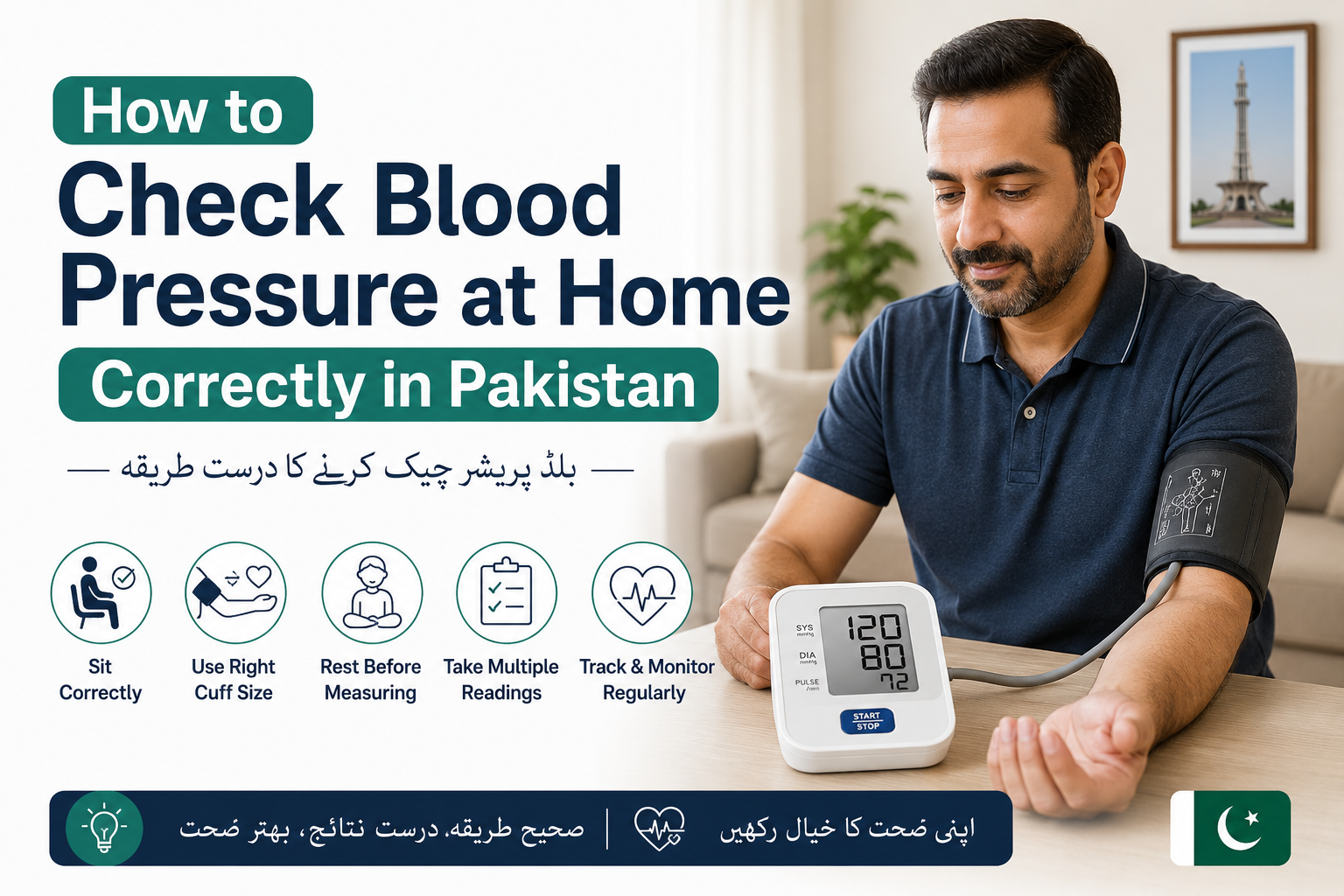
- Sit quietly for a full five minutes before you press start
That five minute rest is the step people skip most often, and it is the one that costs you the most accuracy.
How to Sit for an Accurate Reading
Position changes the number more than most people expect. Get these right every time:
- Sit in a hard backed chair with your back supported, not on a sofa or bed
- Keep both feet flat on the floor and do not cross your legs or ankles
- Rest your arm on a table so the cuff sits level with your heart
- Put the cuff on bare skin, not over a sleeve
- Roll a tight sleeve fully off rather than pushing it up, because a rolled sleeve squeezes the arm
Stay quiet while the cuff inflates. Talking during a measurement can add several points to the result, and so can watching something stressful on your phone.
Taking the Reading Step by Step
Once you are seated and rested, the measurement itself takes about a minute.
Wrap the cuff around your bare upper arm so the lower edge sits about two to three centimetres above the crease of your elbow. The cuff should be snug enough that you can slide one finger underneath, no looser. Most cuffs have an artery marker that should line up with the inside of your arm.
Rest your arm on the table, palm facing up. Press start and stay still until the cuff finishes deflating.
Write the number down, then wait one to two minutes and take a second reading. If the two are close, average them. If they differ by more than five points, take a third and average all of them.
Which Arm Should You Use?
The first time you measure, check both arms. It is normal for one to read slightly higher than the other. From then on, always use the arm that gave the higher number, and stick to that same arm every time.
Switching arms between readings is one reason people think their monitor is faulty when it is working fine.
What Time of Day Should You Check?
Twice a day is the pattern most doctors ask for. Once in the morning before you take your blood pressure medicine and before breakfast, and once in the evening.
Keep the timing consistent. Blood pressure follows a daily rhythm, so a reading at 7 am and a reading at 4 pm are not comparing the same thing.
If your doctor has asked you to build a picture before an appointment, measure twice a day for seven days, throw away the first day entirely, and average the rest. The first day tends to run high while you are still getting used to the machine.
Understanding Your Numbers
Every reading gives you two numbers. The top one, systolic, is the pressure when your heart beats. The bottom one, diastolic, is the pressure between beats. Both are measured in mmHg.
Below 120 over 80 is generally considered normal. Here is the part most people do not know: home readings run slightly lower than clinic readings, so the thresholds are different. A home average of 135 over 85 or above is usually treated as raised, which corresponds to 140 over 90 in a clinic.
Your own target may be different, particularly if you have diabetes or kidney disease. Ask your doctor what number applies to you rather than assuming.
Why Your Reading Changes Every Time
Blood pressure is not a fixed number like your height. It shifts through the day, rises with stress, movement, cold and pain, and settles when you rest. A difference of a few points between readings is normal and does not mean your machine is broken.
What matters is the trend across a week, not any single measurement. This is exactly why a written log beats memory. Keep a small notebook next to the monitor and record the date, time and both numbers. Many digital monitors store readings, but a written log is easier to hand to a doctor.
Readings That Need Attention Straight Away
If you get a reading of 180 over 120 or higher, rest quietly for five minutes and measure again. If it stays that high, contact your doctor without waiting for your next appointment.
If a very high reading comes with chest pain, severe headache, breathlessness, weakness on one side, confusion or sudden changes in vision, treat it as an emergency and get to a hospital immediately. Do not drive yourself.
Common Questions About Checking Blood Pressure at Home
Can I check my blood pressure at home without a machine?
No. There is no reliable way to estimate blood pressure by feeling your pulse or judging symptoms. High blood pressure usually causes no symptoms at all, which is why it needs to be measured.
Are smartwatch blood pressure readings accurate?
Most are not validated for medical use and should not be used to make decisions about your treatment. Use them for general awareness only and rely on a proper upper arm monitor for anything that matters.
Should I stop my blood pressure medicine if my reading is normal?
No. A normal reading usually means the medicine is working. Stopping it without medical advice can cause your blood pressure to climb again. Speak to your doctor before changing any dose.
How often should I replace or recalibrate my monitor?
Have it checked against a clinic device roughly once a year, and after any drop or damage. Cuffs wear out and stretch over time, so replace the cuff if the fabric feels loose or the velcro no longer grips.
Does blood pressure change with age?
It tends to rise gradually with age, but the targets your doctor sets are not automatically relaxed because you are older. Ask what applies to you.
Making Home Monitoring a Habit
Learning to check blood pressure at home properly takes a few extra minutes each time, and those minutes are the difference between a number you can act on and a number that misleads you. Measure at the same times, in the same chair, on the same arm, and write everything down.
Hpharmacy stocks digital upper arm blood pressure monitors, replacement cuffs in standard and large sizes, and the full range of prescribed cardiac medicines. Delivery takes 60 minutes inside Lahore, with cash on delivery available nationwide.
If your readings sit above your target for a week, or if anything about them worries you, book a consultation rather than adjusting your own treatment. Consult your doctor before making any change to your medicines.